Air Duct Repair and Sealing in Pomona, CA
Real-talk answer: Pomona Mitsubishi HVAC repairs, seals, and replaces ductwork across Pomona 91766 to 91768, gauging leakage with a duct blaster and satisfying Title-24 HERS verification whenever the work is an alteration; most older Westmont and Hacienda homes bleed off 20-35 percent of their conditioned air, so call (213) 799-8423 or book online for a duct-leakage test.
The basics
- Duct repair, sealing, and replacement across Pomona 91766, 91767, 91768
- Duct-blaster leakage testing before and after
- Title-24 HERS field verification arranged whenever the job is an alteration
- Duct repair/replace band $1,900-$6,000; sealing-only less
- Ductless retrofit offered where ducts are beyond saving
- We check static pressure so airflow faults get fixed, not masked
- Independent, all-brands shop
Why do Pomona ducts leak so much air?
A lot of Pomona's housing is pre-1970, and the duct systems were taped and panned to 1960s standards that never held up. In Climate Zone 9 heat, a duct losing a third of its air into a 130 F attic forces the system to run far longer, which spikes both the bill and the wear on a Mitsubishi inverter or an old condenser. Sealing the leaks is often the single highest-return HVAC fix in an older home.
| Symptom | Likely cause / first check | Cost lane |
|---|---|---|
| One room never cools, others fine | Disconnected or crushed branch run; visual + duct-blaster | $200-$1,200 |
| High bills, weak airflow everywhere | Leaky plenum/joints; seal with mastic, HERS retest | $600-$2,500 |
| Dusty home, musty smell | Return leaks pulling attic air; seal returns | $300-$1,500 |
| System short-cycles or trips on limit | Undersized/restricted ducts; static-pressure check | $1,900-$6,000 (rework) |
| Whistling or roaring at registers | Undersized return / high static pressure; add return | $400-$2,500 |
| Uneven temps floor to floor | No zoning or leaky trunk; rebalance or seal trunk | $300-$3,000 |
How does a duct repair job actually run?
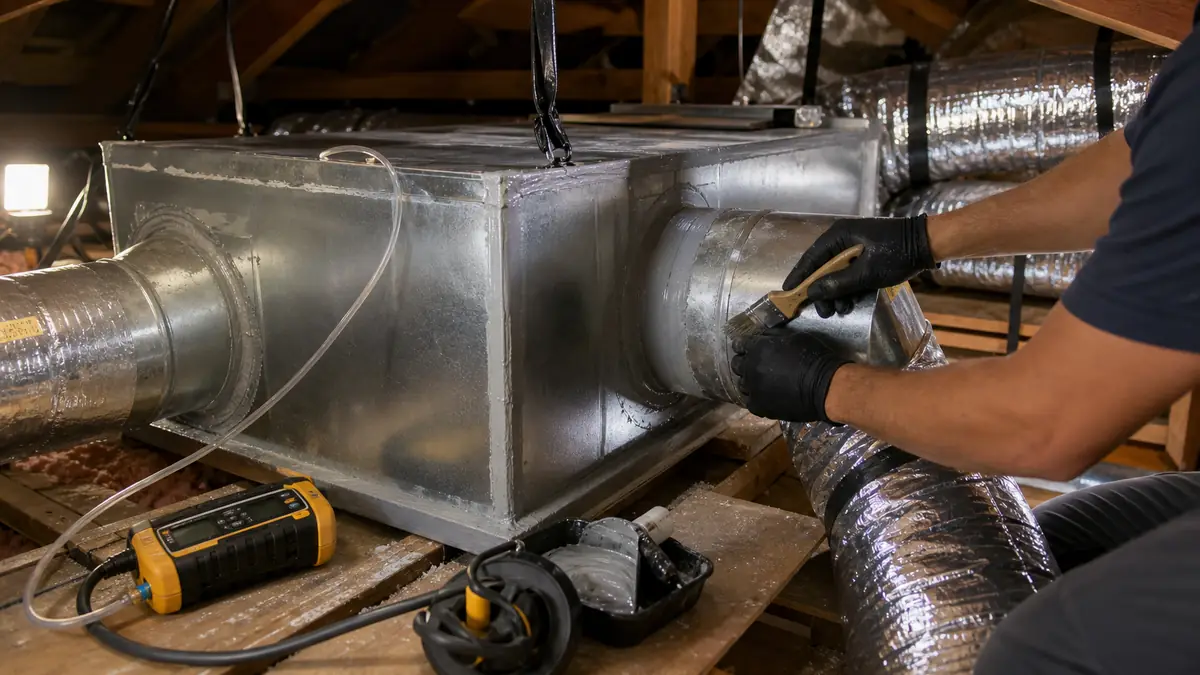
We diagnose before we seal. First a duct-blaster test pressurizes the system through a calibrated fan so we can read total leakage as a percentage, then a static-pressure check across the air handler tells us whether the ducts are also too small or crushed. We walk the accessible runs, usually the attic and any crawl, looking for disconnected boots, failed cloth tape from the 1960s, and gaps at the plenum. The fix is mastic and mesh on the joints, mechanical reconnection of dropped runs, and new insulated flex where a section is beyond saving; we do not rely on tape that will let go in a 130 F attic. After sealing we retest, and on a Title-24 alteration the HERS rater verifies the final leakage number for your certificate. The whole package is sized so a new or existing Mitsubishi system actually gets the airflow its rating assumes.
What drives the cost of duct work in Pomona?
Four things move the number. Access is the biggest: a walkable attic is cheap to seal, while a shallow Lincoln Park bungalow attic or a tight crawlspace under a raised foundation slows everything down. Scope is next, since sealing existing joints costs far less than tearing out and replacing crushed or asbestos-wrapped runs. Home size sets the linear footage of duct to treat. And code adds a fixed layer when the job rises to a Title-24 alteration that needs a permit and HERS verification. That is why the band runs from a few hundred dollars for a targeted seal up to $6,000 for a full replacement; we pin your number to the actual condition after the duct-blaster test, not a guess.
What does HERS verification actually involve?
HERS is hands-off field verification done by a certified rater who confirms the work meets code. On a Zone 9 duct alteration that usually comes down to a measured total-duct-leakage test, and on a full system changeout it tacks on refrigerant-charge and airflow checks. Call it proof your ducts truly hold air rather than a box to tick. We book the rater and put the certificate in your hand, which carries weight at resale.
What should Pomona owners of older homes watch for?
Pre-1980 Pomona homes carry two duct hazards worth naming. The first is asbestos: duct wrap, tape, and register boots in 1950s and 1960s systems sometimes contain it, and disturbing that material is a job for an abatement contractor, not a seal-and-go. We stop and flag it rather than cut into suspect wrap. The second is the attic itself, which in a Lincoln Park bungalow or a Westmont ranch can clear 130 F on an August afternoon; that heat cooks ordinary cloth tape until it lets go, which is why so many of these systems leak a third of their air despite once being sealed. We use mastic and mechanical fasteners that survive that environment, and we insulate the runs so the conditioned air is not warming up before it reaches the room.
When does ductless beat duct repair?
In Lincoln Park's 1900s-1920s Craftsman and Mission-revival homes, there often was never real ductwork, just a floor furnace and window units. Rebuilding a duct system through plaster walls and a shallow attic can cost more than a clean Mitsubishi ductless retrofit, with a worse result. When the bones are bad, we recommend wall-mount mini-splits or a multi-zone MXZ system instead of chasing leaks.
How does duct work pair with a new system?
If you are replacing equipment, seal or repair the ducts in the same project. A new Mitsubishi SVZ/MVZ ducted air handler only hits its rated efficiency if the duct system can deliver the airflow without bleeding it into the attic. We size the ducts to the new air handler and verify the whole package, so the SEER2 on the label is the SEER2 you actually get. See heat-pump installation.
Common questions
How do I know my Pomona ductwork is leaking?
Hot rooms far from the air handler, attic ducts you can feel cold air escaping from, and a power bill that climbs every August are the giveaways. We measure it with a duct-blaster test; older Pomona homes commonly lose 20 to 35 percent of conditioned air before it reaches a register.
Does sealing ducts need a permit in Pomona?
If you replace or substantially rework the ducts, California Title-24 says yes, and that usually drags in HERS field verification of duct leakage. We pull the permit and line up the third-party HERS rater. A straight repair seal is a lighter touch, but we still run a before-and-after test so the gain shows on paper.
Should I seal ducts or just go ductless?
If your duct runs are accessible and mostly sound, sealing is the cheaper win. If the ducts are crushed, asbestos-wrapped, or undersized in a 1920s Lincoln Park home, a Mitsubishi ductless retrofit often makes more sense than rebuilding a duct system that never fit the house.
Can leaky ducts cause my furnace or AC to trip?
Yes. Return leaks and crushed runs starve the system of airflow, which trips a furnace high-limit or ices a cooling coil. We check static pressure as part of duct work, because the airflow problem and the comfort problem are often the same problem.
What does duct sealing cost in Pomona?
A sealing-only job on accessible runs typically falls in the $600 to $2,500 range; a fuller repair or replacement runs $1,900 to $6,000 depending on home size and access. The cost drivers are how much of the system is reachable, whether the attic is a 130 F crawl, and whether HERS verification and a permit apply.
Is it worth sealing ducts if I am keeping an old condenser?
Usually yes. Sealing tends to be the highest-return HVAC fix in an older Pomona home because it cuts run time on whatever equipment you have, old condenser or new Mitsubishi inverter alike. It also lowers the load enough that when you do replace, you can often size down to a smaller, cheaper system.
How long does a duct-blaster test take?
The test itself takes under an hour: we seal the registers, pressurize the duct system with a calibrated fan, and read total leakage. We run it before work to find the problem and after to prove the gain, and on a Title-24 alteration the after number is what the HERS rater verifies for your certificate.
Related: Ducted heat-pump installs · High energy bills · SEER2 and Title-24 · Ductless alternative