Mitsubishi Mini-Split Error Codes in Pomona, CA
Real-talk answer: Pomona Mitsubishi HVAC decodes Mitsubishi fault codes for homeowners across Pomona's 91766, 91767, and 91768 ZIPs, so call (213) 799-8423 or book online and read us the code off the controller. P-codes flag indoor sensors and drains, E-codes communication, U-codes the outdoor unit and inverter (the costly end), and F-codes power on 3-phase gear.
The basics
- Fault-code diagnosis across Pomona 91766, 91767, 91768
- P-codes: indoor thermistors, condensate, protection (P1, P2, P4, P5, P6, P8, P9)
- E-codes: communication and remote controller (E0-E9, EA, EB)
- U-codes: outdoor unit, compressor, inverter (U1-U9, UF, UP, UH)
- F-codes: power/phase, mostly 3-phase P-Series (F1, F2, F3)
- Read via green LED blink count or the wired controller / kumo cloud app
- In-warranty units to authorized service first
What do the Mitsubishi code letters mean?
Mitsubishi groups faults by where the trouble lives. P-codes point at the indoor unit: thermistors, the condensate drain, and protection trips. E-codes are communication and remote-controller problems. U-codes are the outdoor unit, compressor, and inverter, the expensive end. F-codes are power-supply and phase issues, mostly on 3-phase P-Series equipment you will not find in a typical Pomona house.
| Code | Meaning / likely cause | Cost lane |
|---|---|---|
| P4 / P5 | Drain sensor/float or drain pump; clogged condensate, dirty filter | $79-$450 |
| P6 | Freeze/overheat protection; usually dirty filter or coil, low airflow | $120-$400 |
| P8 / U7 | Abnormal pipe temp / low discharge superheat; refrigerant leak | $225-$1,500 |
| P1 / P2 / P9 | Intake / liquid-pipe / coil thermistor open or short | $150-$500 |
| E6 / E7 / EA / EB | Indoor-outdoor comm; loose S1/S2/S3 wiring or control board | $150-$2,000 |
| U6 / UF / UP | Compressor overcurrent / inverter; PCB or DC compressor | $400-$3,500 |
| U2 / U3 / U5 | High discharge temp, discharge thermistor, inverter heatsink | $200-$2,000 |
| U9 | Over/undervoltage; check supply and connections | $150-$2,000 |
How does a tech actually trace a Mitsubishi code?
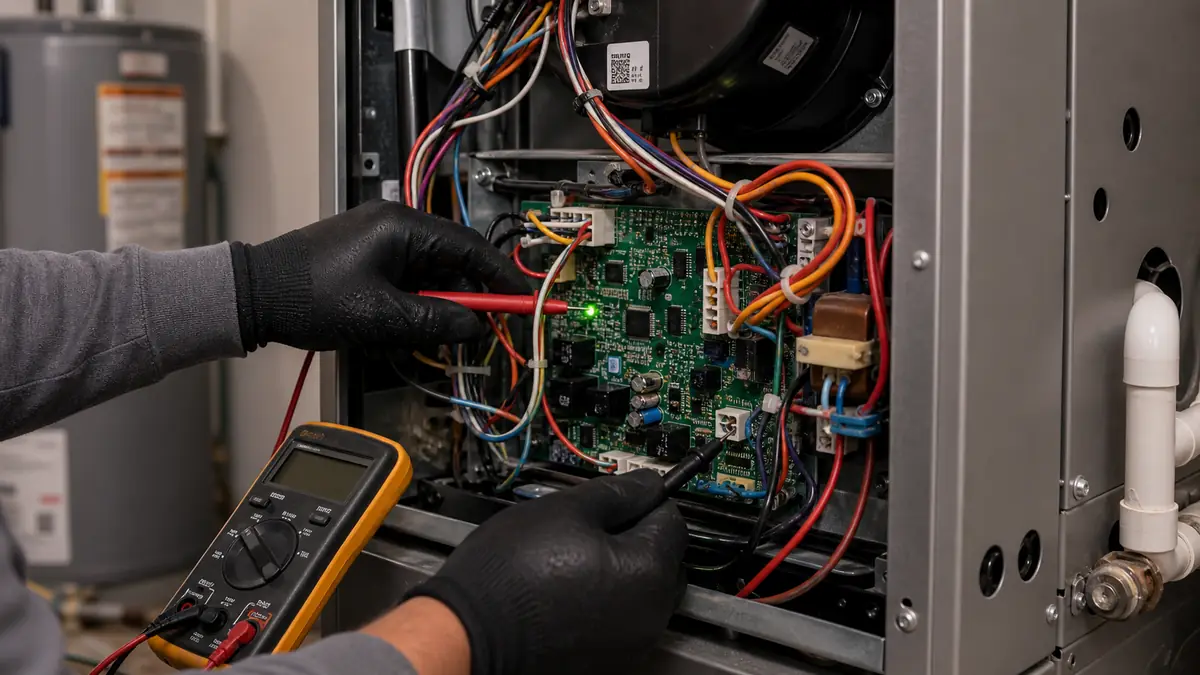
A code is the start of the diagnosis, not the end of it. On site we first read the exact code off the wired controller or the kumo cloud app rather than trusting a blink count alone, then check the obvious airflow path: filter, indoor coil, and the outdoor coil face. For a P-series indoor fault we meter the thermistor in question (TH1 intake, TH2 liquid pipe, TH5 coil) against its resistance curve to tell a drifted sensor from a real protection trip. For a U-code we pull the outdoor cover, check the inverter PCB and IPM for scorching, meter the run capacitor, and put gauges on to read superheat and subcooling so a U7 low-charge reads as a leak rather than a board. For an E or EA/EB comm fault we tighten and ohm out the S1/S2/S3 inter-unit wiring before we ever condemn a control board. Only after the component is confirmed does the repair lane and price get set, which is why the same code can land anywhere in its cost band.
Which codes can I check myself first?
Before calling, handle the cheap stuff. A P6 freeze trip or a P4/P5 drain code very often starts with a clogged filter, so pull and rinse it. Make sure the outdoor unit is not buried in leaves or against a fence choking airflow. Confirm the breaker is on. If the code clears after a clean filter and a cooldown, you may have saved a service call. If it returns, that is real and worth a visit.
Which codes mean stop and call?
Outdoor U-codes, especially U6, U2, U9, UF, and UP, mean the compressor or inverter is in distress; running the unit through them risks turning a board repair into a compressor replacement. A P8 or U7 leak code means you are losing refrigerant, and topping it off without fixing the flare joint just leaks again and harms the system. Repeated E6-EB comm faults point at wiring that needs proper diagnosis. Don't keep resetting these; call.
Why does the same code cost different amounts?
Because a code names a symptom, not a part. A U6 can be a $450 sensor-adjacent fix or a $3,000 inverter compressor; an E6 can be a loose wire (cheap) or a failed control board (not). That is why we read the code at the board, test the actual component, and quote the confirmed repair, instead of quoting the worst case over the phone. See Hyper-Heat U-codes and P4/P5 water faults.
Which codes have their own Pomona repair guide?
Two of the codes above come up often enough on Pomona heads that we wrote a full single-code walk-through for each, with the diagnostic order, the safe homeowner checks, and the local cost lane. Start with the Mitsubishi P8 code page when you see an abnormal pipe-temperature fault, since on most wall units here it traces back to a slow flare-joint refrigerant leak. Go to the Mitsubishi P5 code page when the head shuts down on a drain-pump or high-condensate fault, the classic humid-day call in the older Lincoln Park and Wilton Heights stock.
Common questions
How do I read the code on my Mitsubishi unit?
Two ways: the indoor head flashes a green LED in a counted pattern (with the red timer LED), and the wired controller or kumo cloud app shows the alphanumeric code directly. A slow steady green blink is usually normal standby or defrost; a rapid patterned blink is an error. Read us the letter and number and we arrive stocked.
What does a P5 code mean on my mini-split?
P5 is a drain-pump abnormal or high-condensate fault, often paired with water under the head. It usually starts with a clogged condensate drain or a failed drain pump, sometimes after a dirty filter cut airflow. P4 is the related drain-sensor or float fault. Both are common Pomona summer calls.
Is a U6 code expensive to fix?
It can be. U6 flags compressor overcurrent or an inverter fault on the outdoor unit. Sometimes it is a failing inverter PCB ($400 to $2,000) and sometimes the DC inverter compressor itself ($1,200 to $3,500). We confirm at the board before condemning the compressor, because the diagnosis decides whether repair or replacement makes sense.
My remote shows E6. What is that?
E6 is an indoor-to-outdoor communication fault, frequently a loose or corroded S1/S2/S3 inter-unit connection or a miswire, sometimes a failed control board. On a multi-zone system EA and EB point at the inter-unit cable. We trace the wiring first because it is the cheapest likely cause.
Related: AC repair · Water-leak codes (P4/P5) · Multi-zone comm faults · Maintenance to prevent codes