Furnace Repair in Pomona, CA
Real-talk answer: Pomona Mitsubishi HVAC repairs gas furnaces across Pomona 91766 to 91768, diagnosing ignition, pressure-switch, and high-limit faults on the furnace-plus-AC systems still common in Westmont and Hacienda mid-century homes; diagnostics start near $99 and we quote a Mitsubishi heat-pump conversion alongside, so call (213) 799-8423 or book online.
The basics
- Gas furnace repair across Pomona 91766, 91767, 91768
- We read control-board LED flash codes: lockout, pressure switch, limit, igniter, flame-sense
- Common parts: hot-surface igniter, flame sensor, inducer, pressure switch, limit, gas valve
- Furnace replacement $3,000-$7,500; California Ultra-Low-NOx models common
- Heat-pump conversion quoted alongside any major furnace repair
- Same-day and after-hours service, 7 days a week
- Independent, all-brands shop
What is wrong when the furnace will not heat?
Most no-heat calls trace to the ignition train or a safety trip. The control board flashes a code on its LED: a couple of flashes for system lockout, three for a pressure-switch fault, four for an open high-limit, and patterns for the gas valve, igniter, or weak flame sense. We count the flashes, confirm at the part, and fix the actual cause rather than just resetting the lockout.
| Symptom | Likely cause / first check | Cost lane |
|---|---|---|
| Lights then drops out after seconds | Dirty flame sensor (low flame-sense signal); clean or replace | $120-$350 |
| Clicks, no ignition, hard lockout | Failed hot-surface igniter or no gas; igniter circuit fault | $200-$550 |
| Inducer runs, burners never light | Pressure-switch / blocked flue fault (3 flashes) | $150-$500 |
| Overheats and trips, weak airflow | Open high-limit (4 flashes): dirty filter, dirty coil, or blower | $150-$2,300 |
| Burner shuts down, rollout switch open | Possible cracked heat exchanger; safety inspection | Replace recommended |
| Furnace runs, no warm air, blower silent | Failed ECM blower module or motor; diagnose at the motor | $450-$2,300 |
| Reversed-polarity or grounding flash code | 115V wiring polarity / grounding fault at the board | $150-$400 |
How does a furnace diagnosis actually go?
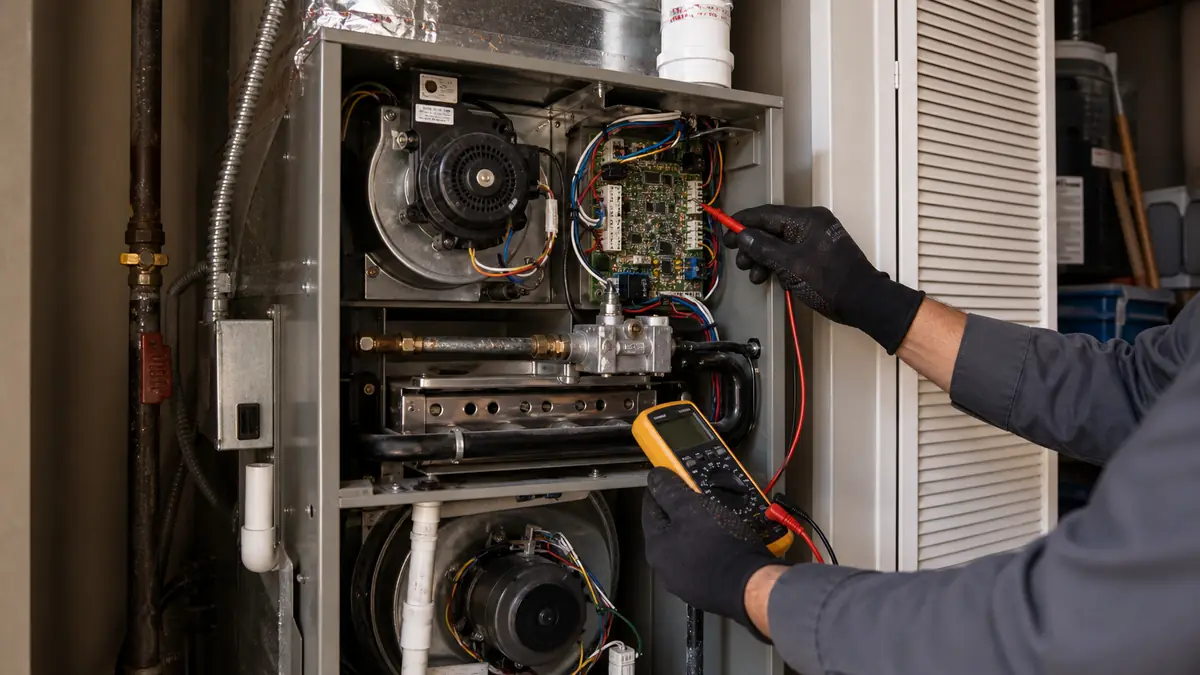
We start at the control board, not the burners. The integrated furnace control flashes a status code on its LED, and that code is the map: two flashes for a system lockout after too many ignition retries, three for a vent or pressure-switch fault, four for an open high-limit, seven for a gas-valve circuit, eight for low flame-sense signal, nine for an igniter circuit problem. We count the flashes, then confirm at the part with a meter rather than throwing parts at the board. A flame sensor gets a microamp reading; a hot-surface igniter gets a resistance check; a pressure switch gets tested against inducer draft; the gas valve gets a voltage and inlet-pressure check. Only once the failed component is proven do we quote it. On a genuine no-heat emergency in a cold snap we carry the common parts, igniter, flame sensor, pressure switch, and capacitor, so the fix often happens on the first visit.
Why do Pomona furnaces fail less than the AC?
Climate Zone 9 is cooling-dominant: 60 to 80 days a year clear 90 F, while winters are mild. Furnaces here log few run hours, so they often outlast their paired AC, then fail on a neglected igniter or a flame sensor caked with years of dust. Because the heating load is light, an 80% AFUE furnace is frequently adequate, and a Mitsubishi heat pump can replace both the furnace and the AC in one move.
When should a furnace become a heat pump?
If your furnace needs a heat exchanger, a control board, or a gas valve and it is past 15 years, repair money is better spent on a conversion. A Mitsubishi air-source heat pump heats efficiently through a Pomona winter and carries the heavy summer cooling you actually depend on, often qualifying for utility rebates. In a cooling-dominant Zone 9 market the math leans this way more than it would on the coast: the system you run hardest is the AC, so paying to nurse an aging furnace while a tired condenser limps alongside rarely pencils out. We always quote the straight furnace repair too, so the choice is yours. See heat-pump installation for sizing, or AC installation if cooling is the priority.
How do we check a furnace for a cracked heat exchanger?
This is the safety question behind every no-heat call, because a cracked or corroded heat exchanger can spill combustion gas, including carbon monoxide, into the air you breathe. The tells are a rollout-switch trip, repeated high-limit faults, soot or scorching around the burner box, flames that lift or roll when the blower starts, and an elevated CO reading at the registers. We inspect the exchanger visually with a camera where we can reach it, watch the flame behavior through a heat cycle, and meter CO in the supply air. A confirmed crack gets the furnace red-tagged and shut down, not patched, and that is usually the moment a Mitsubishi heat-pump conversion makes the most sense, since it removes combustion from the house entirely. We carry a CO meter on every furnace call for exactly this reason.
What about the blower and airflow?
An open high-limit (the 4-flash code) is usually an airflow problem, not a heat problem: a clogged filter, a dirty coil, or a tired blower motor choking return air until the furnace overheats and trips. On variable-speed systems a failed ECM blower module can stop airflow entirely while the board still calls for heat. We check static pressure before condemning a part, because a $20 filter sometimes solves a "broken furnace." Leaky ducts make it worse; see duct repair and sealing.
Common questions
My furnace lights then shuts off after a few seconds. What is that?
Usually a dirty flame sensor: the board lights the burner, fails to prove flame, and locks out for safety. It often reads as a flame-sense or ignition-proving fault on the control board LED. Cleaning or replacing the sensor is a low-cost fix unless the igniter or gas valve is also failing.
Should I repair a 20-year-old Pomona furnace or switch to a heat pump?
If a 20-year-old furnace needs a heat exchanger or control board, replacement usually wins, and in Climate Zone 9 a Mitsubishi heat pump can cover both heating and the cooling you lean on far harder. We quote the furnace repair and the heat-pump conversion so you can compare.
Is a cracked heat exchanger really dangerous?
Yes. A rollout-switch trip or repeated limit faults can signal a cracked or overheating heat exchanger, which risks carbon monoxide. We red-tag a confirmed crack rather than patch it. That is also the moment a heat-pump conversion makes the most sense.
Do you service furnaces if I also have Mitsubishi mini-splits?
Yes. Plenty of Westmont and Hacienda homes run a gas furnace with add-on AC in the main rooms and Mitsubishi heads in additions. We service the whole mix in one visit and keep the controls coordinated.
How much does a typical Pomona furnace repair cost?
Most no-heat fixes land between $120 and $550: a flame-sensor clean is at the low end, a hot-surface igniter or pressure switch in the middle, a gas valve higher. A full furnace replacement runs $3,000 to $7,500, with California Ultra-Low-NOx models standard here. We give you the part name and the lane before any work.
Why does my furnace smell like dust when it first turns on?
After a long Pomona cooling season the heat exchanger and burners collect months of dust, which burns off the first few times you call for heat in fall. A short dusty smell is normal; a persistent burning or acrid odor, or soot, is not, and we inspect for a cracked heat exchanger or a flame-rollout problem.
Do I really need a furnace if I rarely use heat in Pomona?
Many homeowners here do fine letting a Mitsubishi heat pump carry the light winter load and retiring the gas furnace entirely. In Climate Zone 9 the heating season is short, so a single inverter system for both heating and the heavy summer cooling is often simpler and cheaper to own than maintaining a furnace you barely run.
Related: AC repair · Heat-pump conversion · Thermostat setup · High energy bills · All Pomona HVAC services