Mitsubishi P8 Code in Pomona, CA: Pipe-Temperature Faults
Real-talk answer: A Mitsubishi P8 code in Pomona, CA (ZIP 91766) flags an abnormal pipe temperature, most often a slow refrigerant leak at a flare joint, a low charge, or a stuck LEV. Call (213) 799-8423 or book online and we put gauges on to find the actual leak.
The basics
- P8 diagnosis on Mitsubishi heads across Pomona 91766, 91767, 91768
- Meaning: abnormal pipe temperature (TH2 liquid pipe / TH5 coil)
- Top cause here: flare-joint refrigerant leak or low charge
- Other causes: stuck LEV/EEV, drifted pipe thermistor, restricted line
- Components: TH2/TH5 thermistors, flare connections, LEV/EEV, refrigerant circuit
- Cost lane: leak repair + recharge about $225 to $1,500; sensor/LEV lower
- In-warranty units to authorized service first
What does a P8 code mean on a Mitsubishi?
P8 is a pipe-temperature protection trip. A Mitsubishi indoor unit watches two pipe sensors, the TH2 liquid-pipe thermistor and the TH5 coil thermistor, and compares them against the room and outdoor readings. When the spread between those temperatures falls outside the range the control expects, it throws P8 and parks the system rather than let the compressor keep running in a state it reads as unsafe. In plain terms, the refrigerant is not behaving the way it should as it moves through the indoor coil. The most common reason for that on a wall-mount head is that there is not enough refrigerant in the loop to begin with, which is a leak. Less often the liquid-line electronic expansion valve (the LEV, sometimes called an EEV) is stuck and metering the refrigerant wrong, or one of those pipe thermistors has drifted and is simply lying about the temperature. The code names the symptom; the part behind it has to be measured, which is why a P8 can land anywhere from a minor sensor swap to a full leak-and-recharge job.
Why does my Mitsubishi throw P8 in Pomona homes?
Geography and the housing stock both play a part here. Pomona sits at the far-eastern edge of the San Gabriel Valley where it starts to feel like the Inland Empire, so summers run hot and dry with big swings from a 100 F afternoon down into the 60s at night. That daily expansion and contraction works on every flare joint in a ductless line set, and a flare that was torqued a touch loose or a touch tight at install will slowly weep R410A until the charge drops far enough to trip P8. The older core of the city does not help. Many heads in the Lincoln Park Historic District and Wilton Heights were retrofitted into 1920s Craftsman and Spanish-revival walls, where the line set has to run long and around obstructions, adding joints and giving the refrigerant more places to escape. Out in the newer Phillips Ranch and hillside tract homes the runs are cleaner, but a multi-zone manifold there still has a flare at every branch. Add a few seasons of heavy cooling runtime in this climate and a small, slow leak that started as a barely-there hiss becomes a P8 on the controller.
How do you diagnose a P8 code step by step?
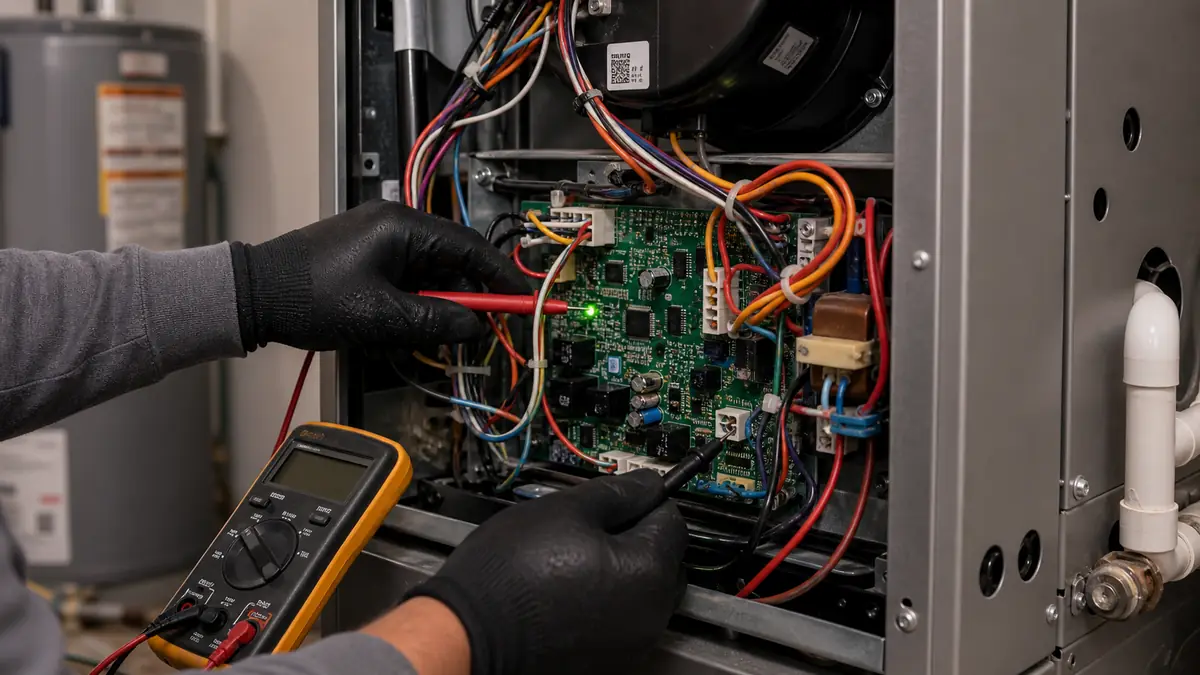
The order is built to separate a real leak from a sensor or valve problem before any refrigerant gets touched. First we read the exact code and any sub-history off the wired controller or the kumo cloud app, because a blink count alone can mislead. Then we pull and inspect the filter and indoor coil to rule out an airflow restriction that skews the pipe readings. Next we meter the TH2 and TH5 thermistors against the Mitsubishi resistance-versus-temperature curve; a sensor that reads way off its curve points at a drifted thermistor or a bad connector rather than a refrigerant fault. If the sensors check out, we connect a manifold and read suction pressure, then calculate superheat and subcooling. Low subcooling with high superheat is the fingerprint of an undercharge, which means a leak. From there we run an electronic leak detector along the flare joints at the head, at the outdoor service valves, and down the line set, and confirm with bubble solution at any suspect fitting. If pressures and charge look correct but the LEV is not opening, we command the valve and watch the liquid line temperature change to confirm the LEV is stuck. Only after the actual fault is in hand do we set the repair and the price, so you are not paying for a recharge on a system that needed a sensor.
What can I safely check before calling a tech?
There is a short, safe list a homeowner can run. Pull the filter on the indoor head and rinse it if it is dusty, because a choked filter can drag the coil temperature far enough to nudge a borderline P8. Walk outside and make sure the condenser is not buried in leaves, blocked by a fence, or baking against a sun-soaked wall with no clearance. Confirm the breaker is on and the disconnect at the outdoor unit is seated. Power the head fully off for ten minutes and let it restart to clear a one-time fault. What you should not do is add refrigerant from a hardware-store can or keep resetting the unit so you can run it through a heat wave. Refrigerant work is licensed for a reason, an overcharge is as damaging as an undercharge, and a system that keeps throwing P8 is low on charge and hurting its own compressor every time it runs. If the code clears with a clean filter and stays gone, great. If it comes back, that is a real leak waiting on gauges.
When is a P8 code urgent?
Treat a P8 that returns after a reset as urgent, because the usual cause is a low charge and a compressor running short on refrigerant runs hot and loses oil return. That is the path from a roughly $300 flare repair to a $1,200-plus compressor. It is more pressing in a Pomona summer, when the system is carrying a full cooling load on a 100 F day and a starved compressor has nowhere to shed the heat. If the head is also icing up, cooling weakly, or you hear the outdoor unit short-cycling, stop running it and book a visit rather than nursing it along. A leak does not heal; topping it off without sealing the flare just leaks again and vents R410A. The cheapest version of this repair is the one caught while it is still a sensor or a single weeping flare, before the charge bottoms out and the compressor pays for it.
What does a P8 repair cost here?
For a flare-joint leak repair plus a weighed-in recharge, plan on about $225 to $1,500 in the Pomona area, with the spread driven by how much R410A escaped, how long the line set runs, and whether the leak is at the head, the valves, or out along the set. A drifted TH2 or TH5 thermistor or a stuck LEV sits at the lower end of that range, since those are part-and-labor jobs without a full recharge. We weigh the charge in by the nameplate rather than topping off to a pressure, so the system ends up at its design charge and the same code does not come back next month. See the Mitsubishi error-code hub for how P8 sits next to the P and U families, and our AC repair page for how a refrigerant call runs start to finish.
Common questions
What does P8 mean on a Mitsubishi mini-split?
P8 means abnormal pipe temperature: the TH2 liquid-pipe or TH5 coil thermistor reports a pipe-to-coil temperature difference outside the safe window. On most Pomona wall units the root cause is a slow refrigerant leak at a flare joint or a low charge, sometimes a stuck LEV or a drifted thermistor. It is the control protecting the compressor, not a random glitch.
Can I keep running my unit with a P8 showing?
No, stop running it. P8 usually means the charge is low, and running a compressor short on refrigerant lets it run hot and starves its oil return, which can turn a $300 flare repair into a compressor failure. Switch the head off, leave it off, and book a leak search before you cycle it again.
How much does a P8 repair cost in Pomona?
Plan on about $225 to $1,500 for a flare-joint leak repair plus a weighed-in recharge, depending on how much R410A the system lost and where the leak sits. A stuck LEV or a drifted pipe thermistor lands at the lower end. We weigh the charge in by the nameplate so you are not paying for a guess.
Why do flare joints leak on Pomona mini-splits?
Flare connections are the weak point on any ductless line set, and Pomona's hot, dry summers and big day-to-night swings cycle the copper, slowly loosening a flare that was over- or under-torqued at install. Many Lincoln Park and Wilton Heights heads were retrofitted into older walls where the line set runs long, giving more joints to weep at.
Related: Mitsubishi error-code hub · AC repair · Wall-mount mini-splits · Maintenance to prevent leaks