Mitsubishi P5 Code in Pomona, CA: Drain Pump & Condensate
Real-talk answer: A Mitsubishi P5 code in Pomona, CA (ZIPs 91766-91768) means the drain pump is abnormal or the condensate level is too high, usually a clogged drain line, a failed pump, or a stuck float. Call (213) 799-8423 or book online and we clear the drain and test the pump.
The basics
- P5 diagnosis on Mitsubishi heads across Pomona 91766, 91767, 91768
- Meaning: drain pump abnormal or condensate level high (float tripped)
- Top cause here: clogged condensate line; algae and dust over a hot season
- Other causes: failed drain pump, stuck or dirty float sensor
- Components: drain pan, drain pump, drain float sensor, condensate line
- Cost lane: drain clearing within a $79 to $200 visit; pump $150 to $400
- In-warranty units to authorized service first
What does the P5 code mean on a Mitsubishi mini-split?
P5 is the way a Mitsubishi head tells you its condensate is not draining. As the coil cools your room it pulls moisture out of the air, and that water collects in a pan under the head. A small float sensor sits in that pan, and on a cassette or a pumped wall unit a tiny drain pump lifts the water up and out to the condensate line. When the float rides too high, because the line is plugged, the pump quit, or the float itself is stuck, the control reads a high-condensate condition and throws P5, shutting the unit down on purpose so the pan does not overflow onto your floor or wall. It is a safety, not a malfunction of the cooling side. The companion code, P4, points more specifically at the float or drain sensor circuit, while P5 leans toward the pump and the water level. Either way the message is the same: water is backing up faster than the unit can move it, and the cooling stays off until the path is clear.
What can I safely check before the tech arrives?
This is one of the few codes with real homeowner first steps, so start here. Switch the head off so it stops making condensate, then pull the filter and rinse it if it is dusty, because a clogged filter freezes the coil and dumps meltwater faster than the drain can handle, which is a frequent trigger for P5. If you can see where the condensate line exits the wall outside, check that the termination is not blocked by dirt, a wasp nest, or landscaping mulch piled against the house. Lay a towel or shallow pan under the head in case water has already collected. What you should not do is keep cycling the unit to force it back on or poke a wire up into the pump; both just push water where it should not go. If the code clears after a filter rinse and the drain runs free, you may have caught it early. If P5 comes back, the line or the pump needs to be opened up and that is our visit.
How do you diagnose a P5 step by step?
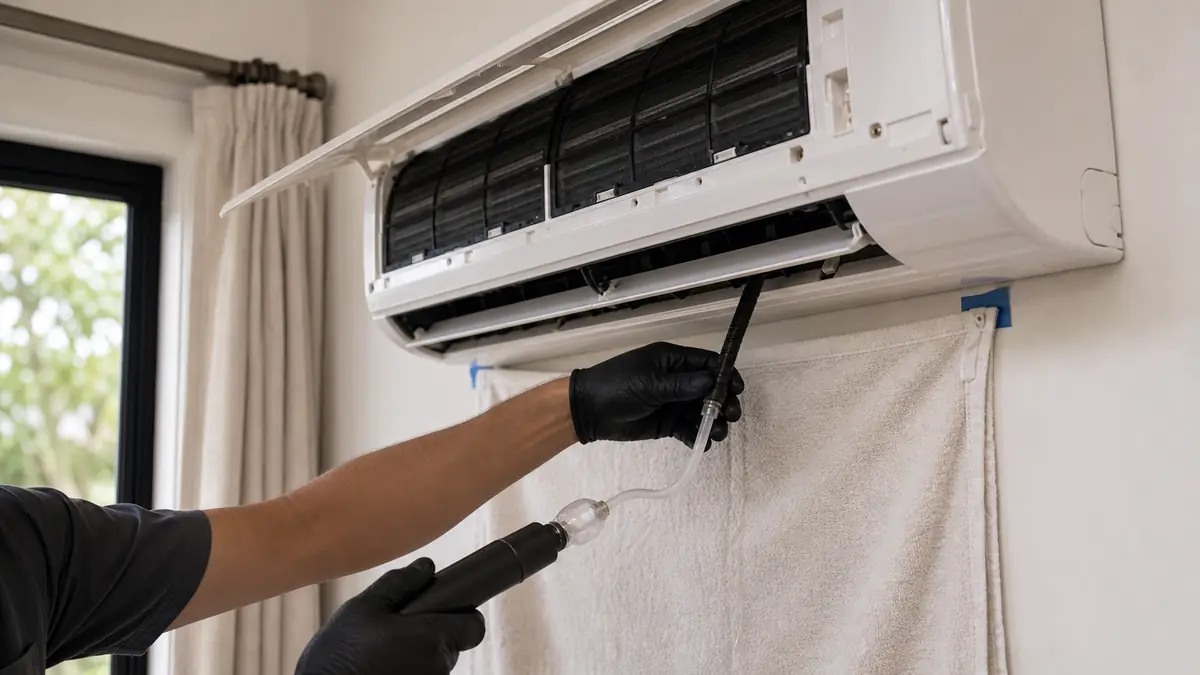
The walk-through is built to tell a simple blockage from a dead pump before any part gets quoted. We start by reading the exact code off the wired controller or the kumo cloud app and noting whether a P4 is riding along with it, which would steer us toward the float circuit. Then we open the head, inspect the drain pan, and check the water level and the float for sludge or a mechanical stick. We pour clean water into the pan and watch whether it clears: if it backs up, the condensate line is the suspect; if it drains but the pump never ran, the pump or its circuit is the suspect. To clear a plugged gravity or pumped line we flush it with a nitrogen or CO2 cartridge or pull the clog from the termination with a wet vacuum, then verify flow end to end. If the pump is the problem we meter it for power and continuity, listen for it trying to run, and confirm the float is sending the right signal to the board. On the older Lincoln Park and Wilton Heights retrofits the condensate often runs a long, low-slope path through an old wall, so we also check the pitch, because a line that does not fall enough will clog again no matter how well we flush it this time. The actual fault, blockage versus pump versus float, sets the repair and the price.
Why does P5 show up in Pomona homes?
Two local realities drive most P5 calls here. The first is the long, hot cooling season; sitting at the eastern end of the San Gabriel Valley near the Inland Empire line, Pomona runs its mini-splits hard for months, and all that runtime grows algae and packs dust into a condensate line until it finally plugs. The second is the housing stock. In the Lincoln Park Historic District, Wilton Heights, and the older Craftsman and Spanish-revival core, heads were retrofitted into walls that were never designed for a condensate run, so the drain often takes a long, nearly flat path to daylight and any slack in that slope sets up a future clog. Newer Phillips Ranch and hillside tract homes have cleaner runs, but a high wall-mount or a ceiling cassette there leans on a drain pump rather than gravity, and a pump is one more part that wears out. Add the late-summer humidity surges that push condensate volume up, and a drain that coasted all year floods exactly when you want the air conditioning most.
When is a P5 code urgent?
P5 is urgent the moment you see water, because the code only buys you so much margin before the pan tops out. If there is already a drip down the wall, treat it as a now problem: shut the head off and keep it off, since every extra minute of runtime adds condensate the unit cannot move. The stakes are higher in certain Pomona homes. Water tracking down a plaster wall in a 1920s Lincoln Park bungalow stains the finish and can feed mold behind it, and on a second-floor Phillips Ranch install an overflow can come through the ceiling below before you notice. Even without a visible leak, a P5 that keeps returning means the drain is failing and will eventually win. The fix is far cheaper than the drywall, paint, and mold remediation a sustained overflow leaves behind, so catching it at the code stage is the whole point.
How do we keep P5 from coming back?
A real repair is more than bailing out the pan. We clear and flush the full condensate line, test or replace the drain pump and float, clean the pan and the coil that feeds it, and confirm the line is pitched to fall the whole way to its termination. On Pomona's heavy summer runtime an annual drain flush is cheap insurance against a repeat, and it pairs naturally with the filter and coil cleaning the system needs anyway. The maintenance calendar sets the timing for that, the water-leak page covers the P4 and P5 codes from the symptom side, and the Mitsubishi error-code hub shows where P5 sits among the P, E, and U families.
Common questions
What is a P5 code on a Mitsubishi head?
P5 is a drain-pump abnormal or high-condensate fault. The float sensor in the drain pan has risen too high, so the control shuts the unit down before water spills out of the head. The usual root cause is a clogged condensate line, a drain pump that stopped pumping, or a stuck float, often after a dirty filter let the coil sweat harder than the drain could clear.
Will water leak out if I ignore a P5?
Often yes, which is the point of the code. P5 fires when the pan fills, and a head that keeps running past it will overflow down the wall. In a plaster-walled Lincoln Park bungalow that stains finishes and can feed mold behind the surface; on a second-floor Phillips Ranch install it can reach the ceiling below. Turn the unit off and clear the cause before more water collects.
How much does it cost to fix a P5 in Pomona?
A clogged drain that just needs clearing and flushing usually falls inside a $79 to $200 visit. If the drain pump itself has failed or the float switch is bad, plan on roughly $150 to $400 for the replacement part and labor. We confirm whether it is a blockage or a dead pump before quoting, because the two repairs are not the same job.
Why does my mini-split throw P5 on humid Pomona days?
A wall head pulls more moisture out of the air during a muggy August stretch, so a drain line that is half-clogged finally backs up when condensate volume peaks. Pomona summers are mostly dry, but monsoon-driven humidity surges push condensate output up just enough to flood a marginal drain that coasted through the rest of the year.
Related: Mitsubishi error-code hub · Water-leak codes (P4/P5) · AC repair · Maintenance calendar