Why Are My HVAC Energy Bills So High in Pomona?
Real-talk answer: Pomona Mitsubishi HVAC traces high summer HVAC bills across Pomona's 91766, 91767, and 91768 ZIPs, so call (213) 799-8423 or book online for a measured diagnosis rather than a guess. In Climate Zone 9, with 60 to 80 days over 90 F, the usual culprits are leaky ducts, a dirty condenser coil, low refrigerant, or an oversized system.
The basics
- High-bill diagnosis across Pomona 91766, 91767, 91768
- Climate Zone 9: 60-80 days a year over 90 F drives heavy cooling load
- Top causes: duct leaks, dirty coil, low charge, clogged filter, oversizing
- Older Pomona ducts often leak 20-35 percent of conditioned air
- We measure airflow, refrigerant charge, and amp draw, not guess
- High-SEER2 Mitsubishi inverters (MSZ-FS ~30 SEER2) cut runtime cost
- Independent, all-brands shop
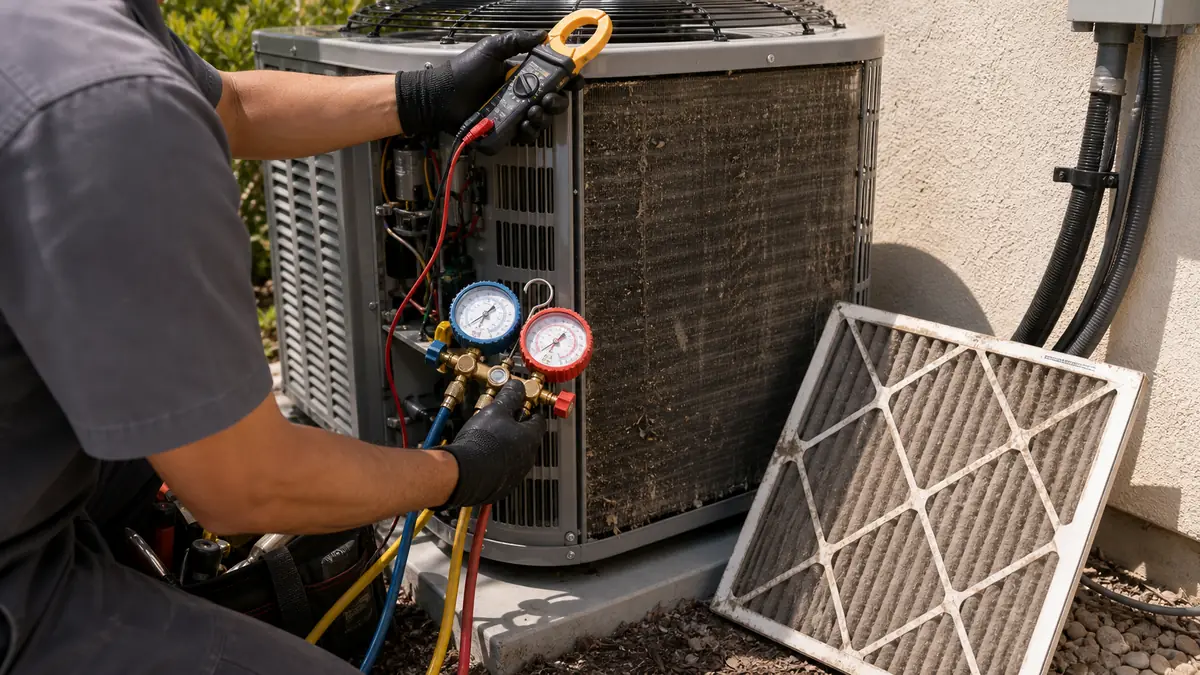
What drives a high bill in Pomona heat?
Cooling is the business here, so anything that makes the system run longer hits the bill hard. A condenser coil packed with Fairplex-area dust sheds less heat; a slow flare-joint leak drops the charge and starves cooling; a filthy filter chokes airflow into a P6 freeze trip; leaky ducts dump cold air into the attic. Each one forces extra runtime in 100 F weather. We isolate the cause by measurement.
| Symptom | Likely cause / first check | Cost lane |
|---|---|---|
| Runs constantly, weak cold air | Low refrigerant from flare leak (U7/P8); leak search | $225-$1,500 |
| Bill up, rooms uneven | Duct leaks; duct-blaster test + seal, HERS retest | $600-$2,500 |
| Outdoor unit runs hot, long cycles | Dirty condenser coil; clean and check amp draw | $150-$400 |
| Short-cycles, clammy rooms | Oversized system; right-size on replacement | Replace planning |
| Old single-stage condenser | Low SEER2; inverter upgrade math | $3,500-$16,000 |
How much can efficiency upgrades save?
The age of the equipment is usually the biggest lever. A tired single-stage condenser at 10 SEER labors far harder than a current Mitsubishi inverter; out here the federal cooling floor now stands at 14.3 SEER2, while top-end heads like the MSZ-FS land near 30 SEER2. Put a right-sized inverter together with sealed ducts and the summer bill can drop in earnest, though what you actually save rides on your home and your habits, so we model it straight rather than dangle a number.
How do you measure where the money is going?
A high bill is a symptom, so we diagnose it with instruments instead of opinions. We start at the outdoor unit with a clamp meter to read compressor amp draw against the nameplate rated load amps; a unit pulling near or over its RLA on a moderate day is working too hard, usually from a dirty coil or low charge. We put gauges on to read superheat and subcooling and weigh the refrigerant decision, because a slow flare-joint leak (U7/P8) quietly adds runtime for weeks before it ever stops cooling. We check airflow and filter loading at the indoor unit, since a choked filter or coil forces longer cycles. On a ducted home we run a duct-leakage test, because a system can be perfectly healthy and still waste a third of its output into a 130 F attic. Each reading points at one fix, and we show you the numbers before quoting it.
Why do Pomona's older ducts cost so much to run?
Pomona's housing skews old, and old ducts leak. Many mid-century Westmont and Hacienda ranch homes still run the original pre-1970 sheet-metal or early flex ducts in an unconditioned attic, where summer temperatures top 130 F. When that ductwork leaks 20 to 35 percent of its air, a third of the cooling you are paying SCE for never reaches a bedroom, and the return side can pull superheated attic air back into the system. Sealing those ducts, mastic at the joints, a proper plenum connection, and a HERS-verified leakage retest, is frequently the single highest-return job on the whole house, ahead of any equipment swap. For the truly duct-starved historic homes in Lincoln Park, the answer is often to skip ducts entirely and zone with a Mitsubishi mini-split, which puts the cooling exactly where it is used with no attic losses at all. Our duct sealing page covers the Title-24 HERS side.
Should I chase efficiency or fix a fault first?
Fix the fault first. A high bill from low refrigerant or a dirty coil is a repair, not a reason to replace; spending $300 on a coil clean and charge check can erase the spike. Only when the equipment is old and inefficient does an upgrade pencil out. We always separate "your system is broken" from "your system is outdated," because they call for very different money. See SEER2 and rebates.
Common questions
My bill doubled this summer with the same thermostat setting. Why?
Something is making the system run longer for the same cooling: a dirty condenser coil, low refrigerant from a slow flare leak, a clogged filter, or duct leaks bleeding cold air into a 130 F attic. We measure airflow, charge, and amp draw to find which one, rather than guessing.
Does a Mitsubishi inverter system really save money in Pomona?
Yes, when it is sized and installed right. An inverter modulates instead of slamming on and off, and high-SEER2 heads like the MSZ-FS sip power compared with an old single-stage condenser. In Climate Zone 9, where you cool 60 to 80 days a year, that efficiency compounds fast.
Could my old ductwork be the real problem?
More often than not. A pre-1970 Pomona duct system routinely loses 20 to 35 percent of its air, which means roughly a third of the cooling you pay for never makes it into a room. Before you spend a dime on equipment, sealing those ducts with HERS verification is usually the fix that pays back hardest.
Will closing vents in unused rooms lower my bill?
No, it usually raises it on a central system by spiking duct static pressure, which strains the blower and can ice the coil. The right way to zone a Pomona home is a multi-zone Mitsubishi system where each head truly shuts off the room it serves.
Related: Duct sealing · Fault codes · Maintenance calendar · SEER2 and rebates